“I see you and I will fight for you”: Hannah Spencer’s glorious victory speech
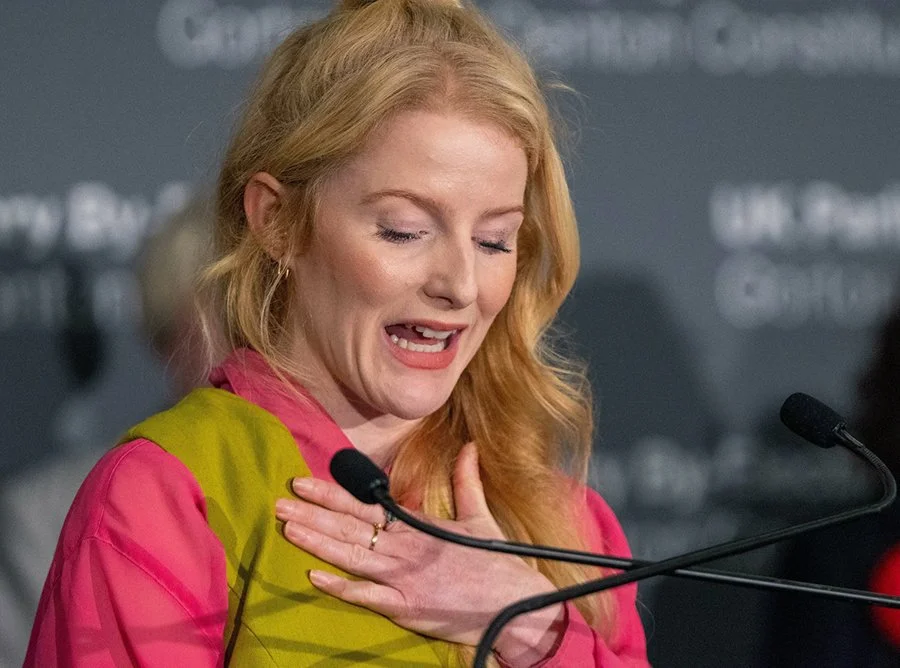
Hannah Spencer, new Green MP for Gorton and Denton, giving her victory speech
What do you picture when you hear the word “orator”? Winston Churchill? Barack Obama? Beardy Greek dude in a toga?
Chances are, it’s not a woman.
Take these contents pages from The Penguin Book of Modern Speeches, which is sitting on the Broom & Moon bookshelf:
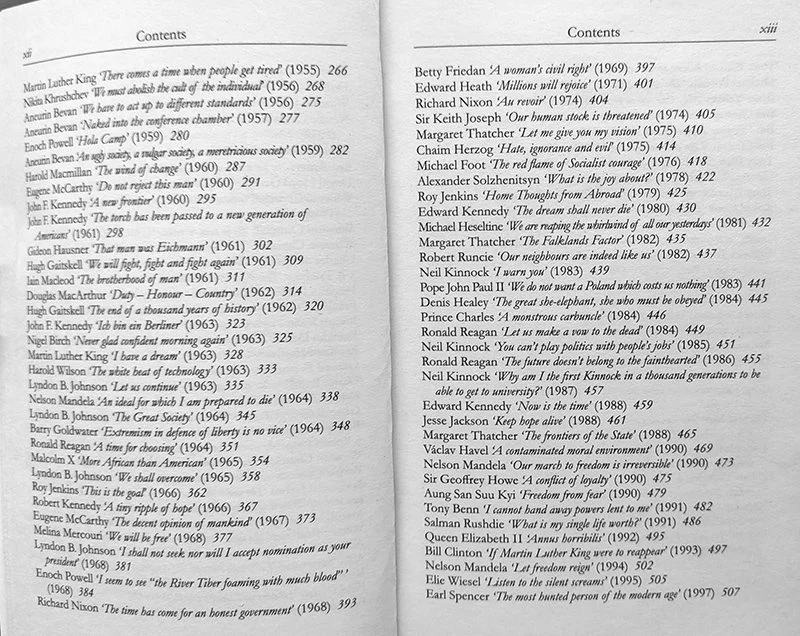
You can (literally) count on one hand the number of female names in that list.
Historically, men have always been more platformed, of course. But when women do speak, are their rhetorical skills recognised?
Remember back in January when everyone was effusing about Mark Carney’s Davos speech? When the LinkedIn feeds of those of us in comms were teeming with praise, not just for what the Canadian PM said, but also how he said it?
Carney, we were told, is the epitome of a brilliant orator. A painter of pictures. A spinner of stories. A wizardly shaper of structure. And, most un-Davos of all, a master of the mic drop.
Consultants declared themselves to be sharing the speech with their clients forthwith — as an example of exactly how to opine from the podium.
Never mind that Carney’s oration was peppered with references to “aphorisms of Thucydides” and “hegemons versus hyperscalers”, not to mention baffling assertions like, “Shared standards reduce fragmentations. Complementarities are positive sum.”
The commentators who praised Carney’s “calm authority”, “commanding presence” and “Goldilocks-Zone voice (neither too loud nor too soft)” unknowingly hint at a source of power that precedes rhetoric.
Might we, then, suggest another recent speech whose effectiveness doesn’t rely, in part at least, on it being delivered by a white, grey-haired man in a suit?
A speech that went largely unremarked on, but that reflects a similarly seismic political shift — albeit national rather than global. A speech that is the very model of how to move a crowd with your words.
Yes, what we’ll be drawing inspiration from when we next create a keynote for a client is the victory speech given in the early hours of last Friday morning by Hannah Spencer, the new Green MP for the constituency of Gorton and Denton, in Manchester, UK.
Here are 4 reasons why:
The satisfying sense of structure
Spencer begins her speech by contrasting her working-class origins with her new job:
“I didn't grow up wanting to be a politician. I'm a plumber. And two weeks ago, during all this, I also qualified as a plasterer.”
Toward the end of the speech, she makes a call-back to that opener:
“Now, to my customers, I'm sorry, but I think I might have to cancel the work that you have booked in because I'm heading to parliament. And when I get there, I will make space for everyone doing jobs like mine.”
Topping and tailing her speech in this way underscores her main message: that she is one of us and working for us. Or in her words: “I see you and I will fight for you.”
The lesson: Begin and open with something concrete that succinctly sums up or symbolises your main theme. For Spencer, it’s the gap between plumber/plasterer and parliament, and how she’s bridging it. (Carney does something similar in his speech, its most powerful element being the “sign in the window” story he opens and ends with.)
And the more visual your symbol the better. In our own client work, we’ve framed CEO speeches around a cancer scanning machine, to symbolise the rising costs of healthcare, and a phone on a bedside table, to symbolise the demands placed on employees serving customers.
The day-to-day rhetoric
Remember when your English teacher used to tell you to find a more “precise” alternative to the apparently overused word “nice”? Spencer, it seems, didn’t get the memo. Listen to this:
“Working hard used to get you something. It got you a house, a nice life, holidays, it got you somewhere.
But now working hard, what does that get you? Because talk to anyone here and they will tell you the people who work hard but can't put food on the table, can't get their kids school uniforms, can't put their heating on, can't live off the pension they worked hard to save for, can't even begin to dream about ever having a holiday ever. Because life has changed. Instead of working for a nice life, we're working to line the pockets of billionaires. We are being bled dry. And I don't think it's extreme or radical to think working hard should get you a nice life. And I don't think that if you're not able to work that you should still not have a nice life.
I think that absolutely everybody should get a nice life.“
Make no mistake: that repetition of “nice life” (and “working hard”) is rhetorical. It is a deliberate drumbeat designed to make Spencer’s message unforgettable.
And that supposedly vague word “nice”? Pair it with the word “life” and everyone’s got an instinctive sense of exactly what it means. (Those mentions of holidays, by the way? In all likelihood a dig at the right-wing Daily Mail newspaper, which, in the lead-up to the election, lambasted Spencer for (shock, horror), having taken several “jaunts” abroad since 2018.)
Let’s compare that with Carney’s more high-falutin’ rhetoric — such as this use of the literary device known as “antimetabole” (the repetition of the same words in an inverted pattern):
“And we are no longer relying on just the strength of our values, but also on the value of our strength.”
Where Spencer’s repetition feels natural (even if it is consciously intended), this feels a bit cringe and contrived, no?
The lesson: The rules of writing designed for reading do not apply to the rules of writing designed to be heard. What might grate on the page can ring in the ears. So don’t be afraid of repetition in a speech. Spencer’s drumbeat tells people: “we’re the party of the nice life, not the eco-zealots the press would have you believe.” Just don’t be too try-hard, OK?
The easiness on the ears
Spencer’s sentences are short and simple. In fact, no experienced speechwriter can listen to Spencer delivering it without picturing the full stops in her script. #NeverNotWorking
That’s because her speech was written to be spoken out loud. And understood easily by any listener, even at 4.30 in the morning after a long day of campaigning.
In contrast, Carney’s speech was written to be read. Or, more accurately, parsed in the future classrooms of International Relations departments. Indeed, the Flesch-Kincaid readability figures do not lie: Spencer’s speech comes out at 7th grade level (fairly easy to read), Carney’s at college level (difficult to read).
The lesson: Beware assuming your audience is as attentive as the elites at Davos, who presumably got there through their ability to digest college-level text, even without seeing it on the page.
Instead, pepper your script with full stops and run it through a readability tool. Another one we love is the Writer’s Diet, which judges Carney’s script “flabby” and Spencer’s “fit and trim”.
If you’re writing a speech for someone else, as we often are, they’ll thank you for giving them the regular pauses that will stop them tripping up mid-sentence.
The authenticity
Spencer’s tone is consistent throughout — and it’s clear this is a speech she wrote herself. The whole thing revolves around her own experiences — and those of her constituents. As in this extract:
“I think that absolutely everybody should get a nice life. And clearly I'm not the only person who thinks that because I've made clear my position and my commitment to working-class communities, the community that I am from. People in their thousands told me on the doorstep and at the ballot box that what we are sick of is being let down and looked down on. That we are sick of our hard work making other people rich. I lived in this constituency in one of the most difficult and challenging periods of my life. I saw how strong the community was of holding things together.”
This isn’t the only example, and she makes abundant use, throughout, of the first person I/me/my (42 times) and we (31 times).
In contrast, we detect several hands in Carney’s speech. We strongly suspect the progenitor of the memorable “sign in the window” story is not the progenitor of the lines of noun-heavy corpspeak like: “We're prioritizing broad engagement to maximize our influence”.
The lesson: If you’re helping a leader draft a speech, be wary of too-many cooks syndrome, where multiple hands can lead to all the feeling being leached (things seem to get more abstract with every round of corporate editing).
Instead, encourage your leader to inject their own voice, style, stories, experiences and even emotions into their speech. A CEO presentation peppered with phrases like “I think”, “I saw” and “I promise” will be far more powerful than one littered with jargonish -isms and other abstractions.
Congratulations, Hannah Spencer. Happy Birthday, Broom & Moon. And all power to our sisters on International Women’s Day.