
The value of values: how to shape a culture where people are bringing you their best day in, day out

Let’s say you employ 30,000 people at different offices and stores around the world. How can you be sure every one of those employees is giving their best to your customers every day?
One word: values.
A strong set of values creates a culture where your people feel connected to your mission. They’re your organisation’s moral compass, governing how your employees treat each other and your customers day in, day out.
They act as a decision-making tool for your employees so that you, as a leader, can have the confidence to know your people will act in a way that makes you proud, even when you’re not there to guide them.
And they also ensure you’re always hiring and keeping the people who are best able to grow your business.
Why do values matter so much?
The power of values became startlingly clear to Broom & Moon’s co-founder, Clare Lynch, during an encounter with the staff at the Chester branch of Halfords, the UK-wide car and bicycle store.
Clare had broken down and a fellow driver who happened to be passing offered to help. As luck would have it, this driver was a Halfords employee on his day off. Sadly, his personal set of jump leads didn’t work on the car’s flat battery, so he drove to the store to summon help from colleagues.
Over the course of two hours, four employees went completely above and beyond to help get the car started. Naturally, as someone with a professional interest in values, the first thing Clare did when she finally made it home was to look up the Halfords values. What she found mirrored her experience exactly:
One Halfords Family: with togetherness and teamwork we have strength and compassion
WOW our Customers: we put customers first and are obsessed with meeting their needs
Be Better Every Day: we act and behave as market leaders
Pride in Expertise: we continually develop our skills to deliver market leading services
How do you get to values that inspire commitment?
If you’ve ever thought values don’t work, maybe you’ve experienced values no one in the org actually connects with — or can even remember.
Perhaps your values were imposed from on-high, with a CEO-endorsed launch campaign. And then quickly uploaded to the intranet never to be seen again.
Or maybe the words integrity, honesty and excellence sit proudly on the wall above reception. Maybe they’ve even made it as far as performance conversations, but everyone knows bonuses and promotions go to the top sellers. Even if those sellers behave appallingly.
In this guide, we show you how to avoid these all-too-common mistakes. We present five rules for uncovering the values that will actually make a difference to your culture — and how to articulate them in a way that minimises the chances they end up dying in a dark corner of the intranet.
Here are those five rules:
Think beyond integrity and other table stakes values
Uncover, don’t impose
Focus on culture, not conduct
Pick the right tone for your org
Aid recall by boiling it down to no more than three
Values rule 1: Think beyond integrity and other table stakes values
How many times have you seen an organisation list values like these:
Integrity
Honesty
Excellence
Trust
Respect
Accountability
Customer-satisfaction
All nice-sounding words, admittedly. But that’s the point: no one can argue with them.
The first problem with opting for values like these is that they make you sound like everyone else. Strong values — ones that truly reflect what’s special about your organisation — will be unique to you. If they’re to genuinely guide your employees in their day to day work, your values should feel true. They should reflect the specific choices they have to make each day. A really powerful set of values will differentiate you from your competitors because others in your industry would not sign up to them.
Another problem with these nice-sounding words is that they are somewhat meaningless in that they are what we call “table-stakes” values: the bare minimum you need to bring to the table if you want to play. Would any organisation ever admit to not being run with integrity, honesty and excellence at its core?
In fact, if you feel the need to shout about how honest, trustworthy and respectful you are, you might make people wonder why that is. A case of protesting too much, perhaps?
Each of the values above fails what we call the “as opposed to” test. It’s a test we recommend all our clients put to any proposed new value. That is, to ask yourself: “As opposed to what? No integrity? Disrespect? A lack of honesty”. If the opposite of your values are things like mendacity, dishonesty and mediocrity, you need to start again.
In fact, such table-stakes values don’t seem to protect organisations from falling foul of the very words they claim to live up to. Indeed, at Broom & Moon, whenever we hear of a corporate scandal, our first instinct is always to head to the values section of the beleaguered firm’s website. More often than not, integrity tops the list.
Take the UK's biggest provider of workplace mental health services, which became the subject of a BBC investigation. The BBC reporters found that the firm had allowed its corporate clients to secretly listen in on counselling calls made by their clients’ employees so they could show them how the service was being run. The calls were, by nature, intensely private. Some were so distressing, even the clients who were secretly listening in needed counselling afterwards. Clearly, a massive breach of the trust and confidentiality you’d expect from a counselling service.
Yet here’s what we found when we visited the values section of their website the day the report came out:
We DO THE RIGHT THING
Integrity is at our core. We always act in the best interest of our clients, communities and each other. We work collaboratively as a team putting others first. We keep our promises and treat everyone with the respect they deserve. That's what earns trust.
Perhaps the people who allowed this breach of trust to happen genuinely thought they were doing the right thing by prioritising the paying client over the distressed employee. Indeed, it’s notable that the people calling the helpline are completely absent from this value. And, indeed, all the other values this organisation espouses to this day, including:
We CARE
Our passion, commitment and dedication comes from our genuine care to help others build great organisations.
The point here is that acting with integrity isn’t about a set of nice-sounding words on a website. Sometimes it requires you to take unpopular decisions. It can — and probably should — demand that you make difficult choices between competing interests. Like the interests of the client who pays your bills versus the interests of their employee using your service.
In this example, many of the employees themselves knew what was going on — and told the BBC they had grave concerns about it. An honest, company-wide conversation about the company’s true values may well have uncovered the failures before the BBC did.
Which brings us on to our next rule…
Values rule 2: Uncover, don’t impose
Your employees know what really gets recognised and rewarded in your organisation. They also know what matters most to them. In short, your employees own your values.
If you impose a set of values on your people rather than asking them what they value, you’ll end up with values they don’t recognise as true.
Values created in your boardroom behind closed doors will also likely lead you to sounding like every other company, with the same old values that don’t capture what makes your place special.
At best, your values will be a wish-list.
At worst, they’ll be so off-kilter — so different from what your people see around them every day — that all they’ll do is breed scepticism among those you’re forcing them on.
A better approach is to have a company-wide conversation about what your people really value — and what they see is valued by those around them.
Even better if that conversation includes frank discussions about how those values play out in the trickiest decisions employees may face — like the decision to prioritise a paying client’s demands over what they sense to be right.
An example of values being uncovered from bottom-up, rather than imposed top-down is our client Afiniti, a provider of AI to contact centres.
The new CEO wanted Afiniti to be known as a values-driven organisation so we recommended a company-wide consultation to uncover what Afiniti’s employees saw as their shared values.
The consultation included a short survey, which got 700+ responses as well as workshops with a group of 185 culture champs from all over the business.
The values that came out of that research landed extremely well with employees and leaders. People said they felt distinctive and authentic because they reflected what was truly special about their workplace. For a more detailed account of this values consultation — and to see the values that came out of it — read our case study.
Values rule 3: Focus on culture, not conduct
Recently, we were challenged on our antipathy to values like integrity. “You still need table stakes!” said a strategy consultant who we were collaborating with on a client project.
In this particular instance, the consultant wondered why Responsible had not made the cut when it came to the three values we’d recommended for our mutual client. Now, this particular consultant specialises in working with companies that operate in highly regulated industries — so we totally got where they were coming from.
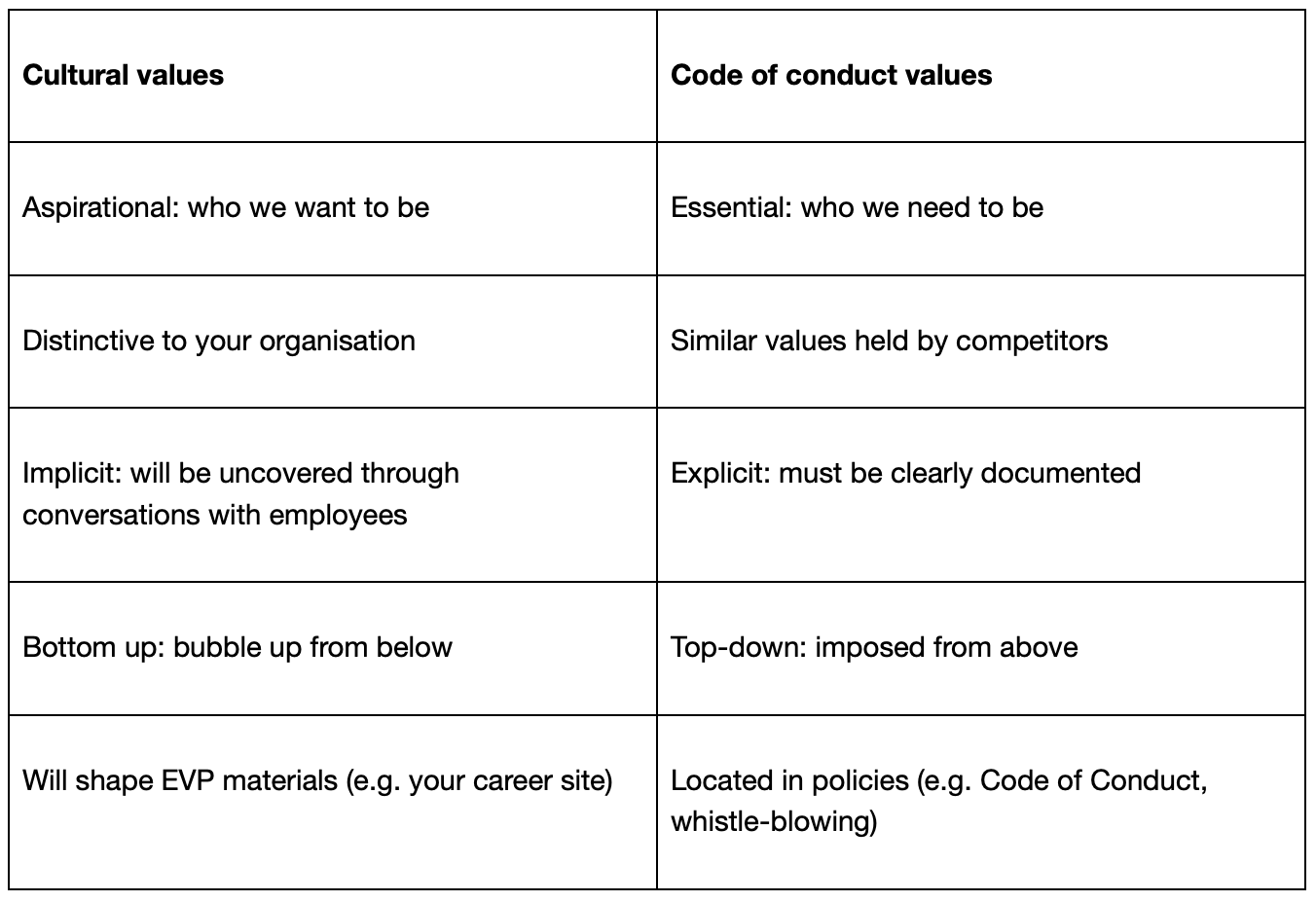
And our response to their challenge? We agree! It was true that acting responsibly is essential if the organisation in question is to remain in business. But, we replied, documenting the firm’s commitment to responsibility is the preserve of its code of conduct. If your code of conduct is fit for purpose, you shouldn’t need to shout about the basic ethical standards every employee is expected to adhere to.
The values we, at Broom & Moon, help companies articulate go beyond such basic corporate “hygiene”. They’re the values that capture what’s unique about your org and its culture.
Both types of values will guide employees’ behaviour — but in different ways. Here’s a handy summary of the differences between the two:
Values rule 4: Pick the right tone for your org
As with all aspects of your brand, when it comes to your values, tone of voice matters. That is to say, you have choices when it comes to the format your values take. Here are four types of values we typically see. The option you choose will depend on your culture.
Traditional values
Traditionally formatted values take the form of a single word. They might be abstract nouns like innovation, collaboration and accountability. Or adjectives like innovative, collaborative, accountable.
These are the types of values people most often expect to see. They don’t rock the boat in terms of style, so they are, perhaps, appropriate for cultures where stability matters most.
Pros: They’re for orgs where it’s important to do things properly and in a controlled way. So they might be your preferred choice if you’re operating in a highly regulated industry, like banking or law.
Cons: One of the drawbacks of traditionally formatted values like these is that those single words have to do a lot of heavy lifting, meaning it can be hard for the team to agree on just three. They also lack originality. If you want to be seen as a highly distinctive brand with a unique tone of voice, you may prefer one of the other approaches.
We-statement values
We-statement values do what they say on the tin. They tell the world what we, at this org, are like and how we all work together. An example would be these values from the software company Teradata:
We dig deep and aim high.
We rise as one.
We raise up our customers and our world.
Pros: These types of values work best for organisations that have a warm, inclusive culture, where employees are open to collaboration. They convey a sense of belonging and pride in collaborating toward a shared mission.
Cons: We-statements might not work for you if your values are still aspirational. When a team takes the step to uncover their values, it’s not unusual for them to identify values people are not yet fully living. Instead, they opt for values they want to be known for — and want people to work toward. If those values aren’t yet fully understood and embedded across the org, expressing them as we-statements might ring hollow.
Yoda-ish axiom-type values
What we call “Yoda-ish axioms” are short aphorisms that sum up the org’s philosophy. A famous example is Google’s “Ten things we know to be true”, a list that includes dicta such as:
You don’t need to be at your desk to need an answer.
You can make money without doing evil.
You can be serious without a suit.
Pros: This approach works well for organisations with a distinctive brand and culture that, like Google’s, emphasises new ways of doing and thinking.
Cons: They might not work for you if your culture is a more traditional one, where such sayings might be perceived as inauthentic and, well, a little bit cringe. Be aware, too, of the risks of being perceived as not living up to your stated philosophy (Google’s “don’t be evil” line being a case in point).
Imperative-verb-phrase values
These types of values include an imperative verb — that is, the command form of an action word — paired with another word. A great example is the set of values we uncovered for Afiniti: work smart, be open and spread joy.
Pros: Thanks to that imperative verb, these types of values have a distinct energy about them. They work well for most organisations, but particularly ones where your people will be motivated by bold calls to action.
Cons: Few cons with this type — they will work well for most orgs.
Values rule 5: Aid recall by boiling it down to no more than three
We’ve seen many examples of companies with long lists of values. Five or six values is typical, but it’s not unheard of to find an organisation with up to 14 different values.
In our experience, even five is too many. In fact, we we recommend three values, max, to our clients. Any more than three and your people will find it hard to recall and repeat them.
We know, because we’ve seen it happen. By the time it gets to listing the fourth value, people will invariably stumble as they try to bring it to mind (unless it’s something spectacularly memorable like Give a shit, which you can read about in our Mi9 case study).
And if your people can’t even remember your org’s values, the chances of those values shaping how people work are slim.
Not only that. If the purpose of values is to have your people focused on the right things, pointing those people in 14 different directions is a recipe for confusion.
It’s also likely to be a symptom of a lack of unity among the leadership team who came up with such a long list.
Sticking to three values will put you within a millennia-long rhetorical tradition that suggest the brain is hotwired to remember things in threes. Just think of a famous saying like Blood, sweat and tears. In Winston Churchill’s original speech, the phrase was actually blood, toil, tears and sweat, but no one ever remembers toil. Likewise, if you decide to adopt even just four values, one of those values will invariably be dropped in day-to-day use.
What if you were really brave and focused — and opted for just one value? A single, unifying principle that tells people exactly what you expect of them?
In their book Made to Stick, Chip and Dan Heath tell the story of the owner of a local newspaper in the US, who gives his employees just one guiding principle to live and work by: names, names, names.
This principle is founded on understanding why people read their local paper: to spot their own name or the names of people they know. So every reporter on the paper knows their goal when writing a story is to quote as many local people as possible. Every photographer knows that if they’re covering a library opening, they need to snap a big crowd in front of that shiny new building.
In other words, names, names, names tells the newspaper’s employees exactly what they need to do and how to do it.
Could one value be enough for your team too?
What to do next
Download our guide The Permissionless Organisation: How to create a strategic narrative that aligns your leaders, empowers your employees and speeds up execution
Talk to us about uncovering and articulating your team’s values.
Want help uncovering, articulating or bringing to life your narrative?