
Start-up to scale-up: a founder’s guide to shaping a narrative that wins customers, inspires teams and excites investors

If your startup is to grow fast, you need to be able to tell a consistent, compelling story. One that tells people what your business does, where it’s going and why people should believe in it. In other words, you need a clear company narrative.
Your narrative talks about who you are, the problem you solve, and why the world needs your solution to that problem. It’s what you say:
to customers on your home page
in discussions with talent you want to hire
in the pitch deck that wins you the funding you need to grow
Above all, your narrative is how other people describe your company when you’re not in the room. When they’re:
Recommending your product or service to a colleague
Urging a friend to join the team
Putting you forward at their next investor committee meeting
In other words, having a clear, consistent narrative is essential if you want to make the journey from start-up to scale-up. Taking the time to distil what you do — and why — into simple, memorable compelling language will pay off in faster growth and more impact.
This guide will show you how to craft a narrative to win customers, align your whole team, and persuade investors to part with their cash.
The central element of a great narrative: your purpose
The starting point of every great narrative is a strong purpose statement. This is your one-sentence introduction that instantly tells people who you are and what you’re all about.
Your purpose statement is not simply a description of your product or a service. It’s not just about what you do, but also why you do it.
To identify your purpose, you may need to do some digging. What you’re looking to uncover is a clear story about who you are and how you make the world a better place.
The people who can best help you do this? Your customers.
So talk to them — and to your customer-facing teams.
Pick up the phone. Listen to what customers are saying in their feedback or on social media. How do they talk about the difference you make to their lives?
Have a conversation about purpose with your wider team, too. Questions you will want to answer include:
Who do we serve? (Wrong answers: everyone, society, the planet)
The answer to this question should be as niche as possible. Ideally, you would paint a clear and precise picture of one, particular customer, with their particular pains and motivations.
How do we make life better for the people we serve? (Wrong answer: we provide a product or service)
With this question, you’re digging into the impact you have on your customer. You won’t find that impact in the name of a product or service. You’ll find it in the positive difference your product or service makes to your customer’s life.
What makes us different? (Wrong answer: we’re the best at what we do)
A strong purpose will be unique to your organisation. It will be recognisably yours, not your competitors’. So really interrogate what it is that sets you apart. And don’t just think about what you do better or best. Think about what you do that’s different from everyone else. What do you do that your competitors would never do? Either because it’s beyond their expertise or because it’s off brand for them? That gap is where you’ll find your purpose.
Hooking investors with your narrative
It’s particularly crucial to be able to articulate your purpose if you’re going after funding. Here’s what Holly Branson, Chief Vision and Purpose Officer at Virgin says on the appeal that purpose-driven start-ups have for her as an investor:
I’ve seen how purpose-driven businesses go further faster, and find more success. So when we look for a new start-up to invest in, we really look for businesses that are driven by a strong purpose to make the world a better place and use innovation to drive this progress forward.
Likewise, Conor Moore, Partner at KPMG has noted the growing role of purpose in investment decisions, saying:
The past two years have had a remarkable impact on the world of innovators, entrepreneurs and impact investors, with purpose and profit carrying equal weight.
So how do you persuade investors you’re as purposeful as you are profitable?
Chris Tottman, one of the founders of Notion Capital, a European investor in early-stage business software, says that when an investor reads your purpose statement, what they’re always asking is: Do I understand what this company does in the time it takes to read one sentence?
In fact, when reviewing any pitch deck, Tottman says he’ll give the purpose statement a mark out of five. He awards five to any statement that names the customer, the product, and the value in under 12 words, with zero category jargon. He gives a score of just one to any sentence that needs a second sentence to explain what the first one meant.
In answering these questions, the temptation can be to produce something that sounds impressive on the surface, but says little when you dig deeper. Here are some examples of real-life grand-sounding purpose statements that fail to tell people what the organisation in question actually does.
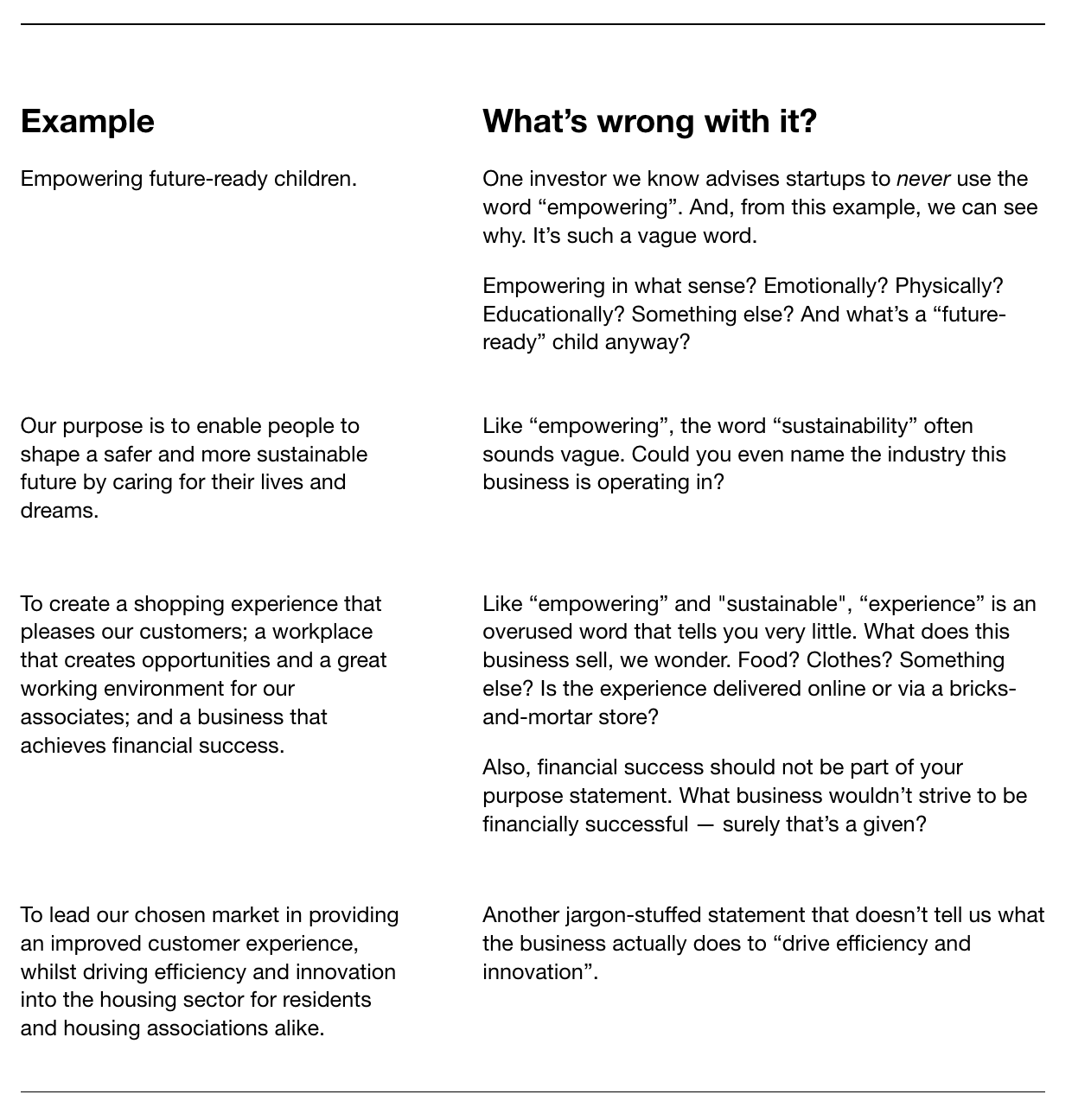
Compare these with the purpose statement AirBnB used in the legendary pitch deck that famously won its founders $600K in seed funding:
Book rooms with locals, rather than hotels.
In seven clear, ordinary words, they’ve told us exactly what they do — and why it matters.
Guess which of those two types of statement is going to hook an investor like Tottman and keep them reading? And which will have him hitting the delete button?
The purpose statement was just one element in AirBnB’s pitch that proved highly persuasive. If you’ve never seen this deck before, prepare to be blown away by its clarity, simplicity and persuasive power.
Here’s a selection of slides:
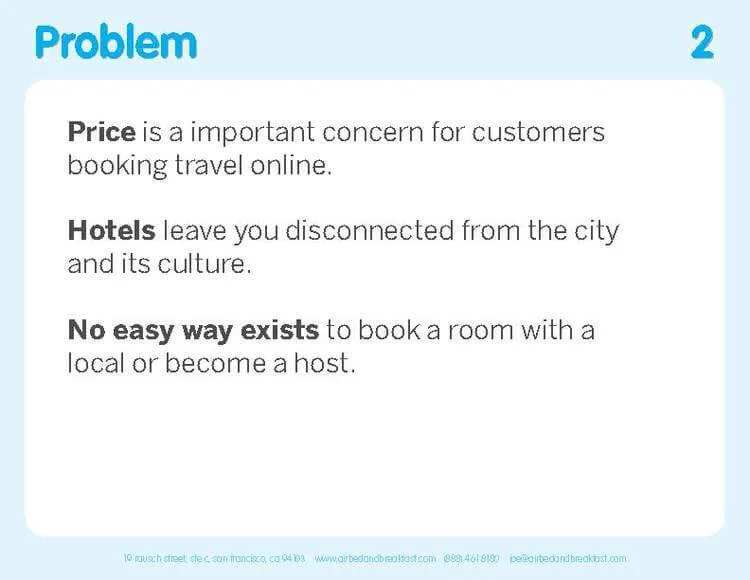
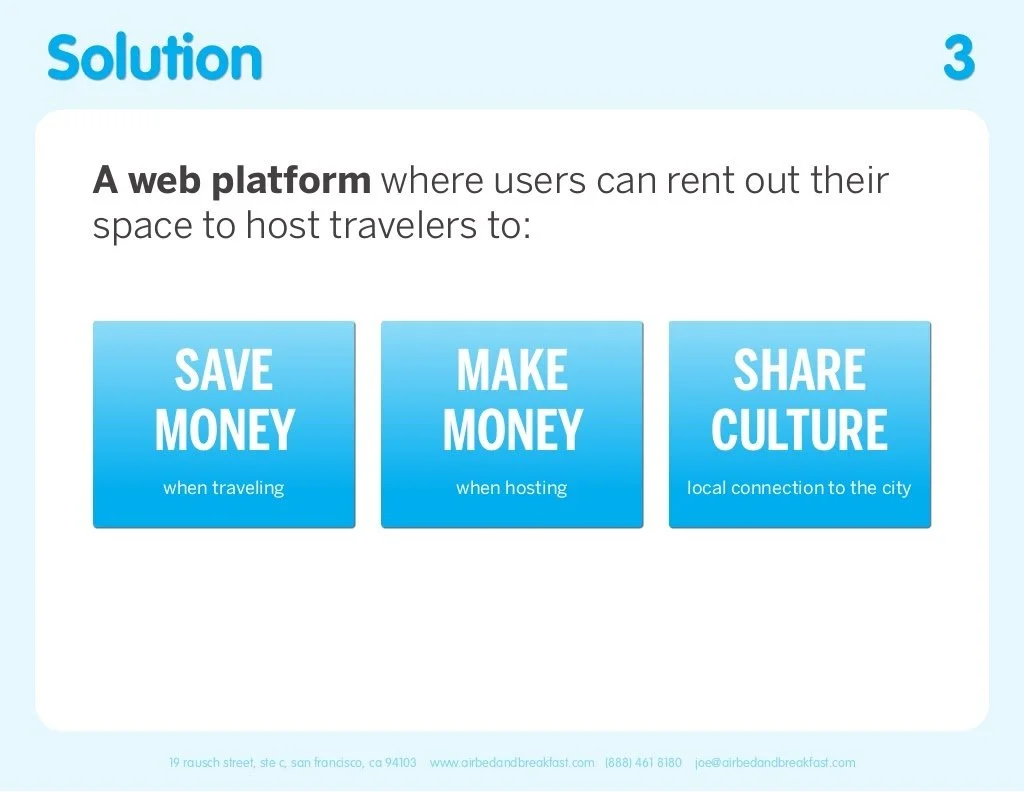
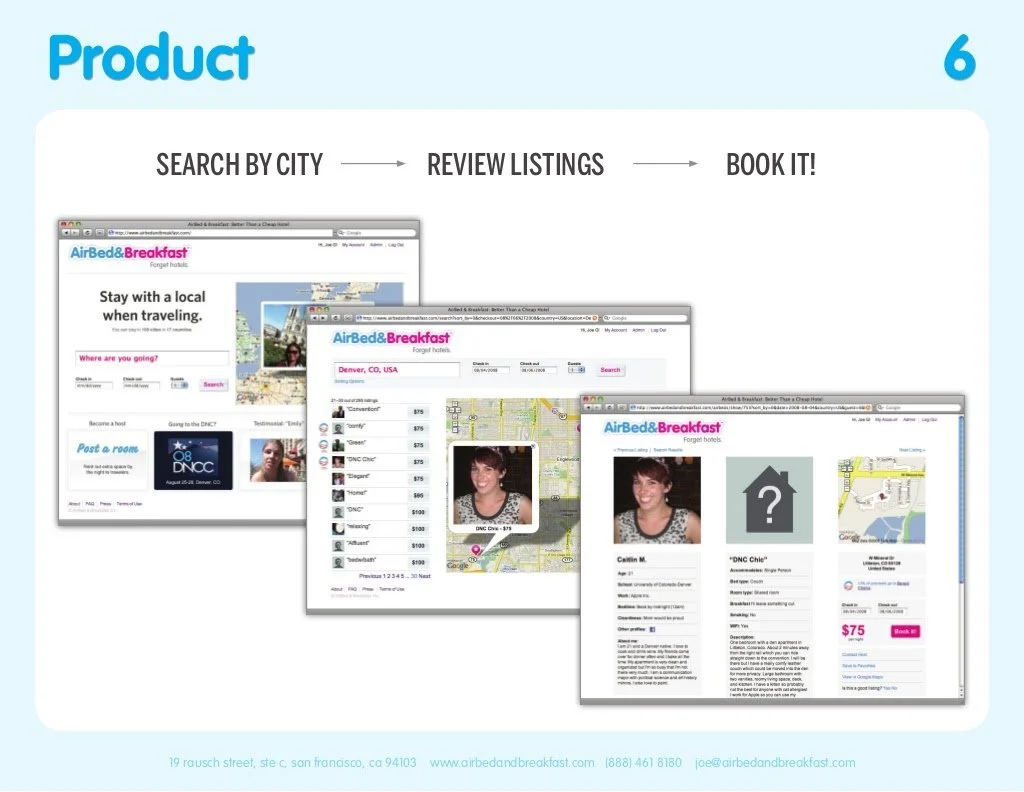
What you’ll notice about these slides is just how clear and clean they look. The text is simple and easy for a non-insider to understand. The emphasis is on highlighting customer pain points — expressed in the language of customers — rather than the technical specs of the product.
All of which contributes to telling the AirBnB story quickly and efficiently. With research showing that VCs typically spend 3 mins max reviewing a pitch deck — and generally like to see no more than 35-50 words per slide — that matters..
Want another reason to avoid trying to impress that VC with fancy, complex or over technical language? Research by psychology professor Daniel Oppenheimer has revealed that using long, complicated words doesn’t impress readers. The opposite in fact: in his experiments, needlessly using complex language actually led people to judge the authors as having lower intelligence. In other words, simple looks smarter than complex.
Inspiring your team with your narrative
Let’s say you’ve achieved the dream of every start-up: winning the investment pitch that allows you to grow your business and accomplish your mission. Post raise, the pressure’s on to fulfil the promise you’ve made to your investors — and your employees are the people you’ve entrusted to do that. So after all the excitement of the fundraise, you’ll want to refocus them on delivering on that promise.
Plus, chances are, your team will be growing fast. And up till now, keeping everyone on the same page might have been easy. But what happens when you become more than a handful of people thrashing things out around a table?
As your team expands, you’ll need to become much more intentional about making sure:
everyone’s focused on the right things, even when you’re not there to guide them
all decision making is aligned with your purpose, strategy, values, goals and long-term vision
your people are motivated to deliver for you and your customers — day in, day out
you’re nurturing a culture where people feel happy, connected and heard
you’re creating the conditions for constant innovation
you’re hiring and keeping the people who are best able to grow your business
A clear, purpose-based narrative can help you succeed on all these points. But while it’s one thing to have a clear, concise purpose statement that wins over investors, it’s a whole other thing to have your people living and breathing that purpose every day.
To make your purpose statement more than just words on a wall, you need to be proactive about embedding it into the very fabric of people’s work. Mark Weinberger, Global Chairman and CEO of EY, agrees. In a report on the role of purpose in powering business growth, he says:
The real test of an organization’s purpose is figuring out how to make it more than just words in a memo. For purpose to really matter, it needs to go beyond an initiative that sits on the margins of the organization.
Do you suspect there’s scope to make your org’s purpose “more than words on a memo”? Here are some questions to ask:
Has your organisation ever explored its purpose, vision, strategy and values? Do people talk about these things? Could they speak them out loud? If not, why not? What’s holding you back?
If you have uncovered your purpose, vision, strategy and values, have you articulated them? Are you confident everyone is clear on the organisation’s overall narrative?
If people are talking about the various aspects of your narrative, what are they saying? Do they talk about them in positive terms? If not, why not?
Does your narrative — your purpose, vision, strategy and values — accurately capture who you are today, and who you aspire to be, as a team, tomorrow? Does this moonshot “feel” right?
Is every aspect of your narrative current? Or does any of it need updating to reflect recent organisational changes?
When it came to uncovering your narrative, did you engage people at all levels of the organisation? Or have your purpose, vision, strategy and values been imposed from top down?
Have you embedded your narrative into the very fabric of your organisation? Do you and your people regularly talk about your purpose, vision, strategy and values? If not, why not?
Do you have evidence that, on a daily basis, people are:
Inspired by your purpose?
Motivated by your vision?
Contributing to your strategy?
Living your values?
Once you’ve articulated your narrative for employees, a great way to put it to work is though a decision-making filter. This is a document that acts as a guide for team discussions about what to focus on. It takes the form of a series of questions designed to test any decision against the various aspects of your narrative (vision, purpose, strategy, values).
Considering a new product line? Entering a new market? Put the move through your decision-making filter. If the idea isn’t aligned with your narrative, it’s rejected. Or it goes back to the drawing board — to fuel further innovation in a different direction.
Winning customers with your narrative
Having a clear narrative isn’t just vital for securing investment and aligning your team. It’s also essential for bringing in customers.
As with pitch decks, all too often, we see customer-facing websites that bury the organisation’s narrative in impenetrable industry jargon and long lists of tech specs. But to be effective, your narrative must communicate the benefit of your product or service, not just list its features. It must speak to your customer’s heart more than their head. And it must do so in the customers’ language.
Investor Chris Tottman agrees. In Would Anyone Notice If Your Competitor Stole Your Homepage?, he says:
“We are an AI-powered platform that uses machine learning to optimise X” isn’t a message. It’s a product description, and it forces the buyer to do the interpretation. Buyers no longer interpret. They discard.
Lead with “how” and you’ll lose even faster. “We unify data across systems using our proprietary engine” may be entirely true, and it’s still not the reason anyone will care.
Lead with why it matters, which usually means pain, consequence and outcome, in plain English, in the Economic Buyer’s own voice. If a twelve-year-old can’t read your homepage and explain what you do, the language is too complicated. Complexity isn’t sophistication. It’s usually fear, because vague language lets you hide and clear language forces you to commit.”
Here’s another real-life example of a business that fails to use the customers’ language in its summary of what it does:
“Our purpose is to transform the digital productivity of SMBs in Northern Ireland by providing subscription-based, enterprise-class cloud computing solutions that are secure at any time, in any place and on any device.”
Let’s assume SMBs stands for small and medium businesses. How many of this business’s customers do you think ever talk about their need to “transform their digital productivity with a subscription-based, enterprise-class cloud computing solution”?
In particular, how many of them would ever use such language to recommend this company to a friend or colleague? (Remember, a successful narrative gives people the words they will use to talk about your company when you’re not in the room.)
The common trap that businesses like these fall into is trying to impress. With such complex and somewhat self-congratulatory language, they are positioning themselves as the hero in their own narrative. As the business journalist Geoffrey James notes in his book How to Say it: Business to Business Selling, that’s a big mistake. He says:
“Every sales message is a story. Unfortunately, it’s usually the wrong one.
Every good story has a hero, a goal, and supporting characters. In lousy sales messages, your firm is the hero, the goal is making a sale, and the customer is a supporting character who either helps or hinders that sale.
In effective sales messages, the customer is the hero, the goal is what the customer wants to accomplish, and your firm is a supporting character who helps that customer achieve that goal.
In other words, when you’re writing your sales message, don’t try to be the hero who conquers the dragon. Instead, try to be the wizard who gives the hero the magic sword, so that the hero can conquer the dragon.”
Our advice to founders seeking to scale?
Be less hero and more wizard. Your prospect doesn’t need to know every last detail of how your company’s product works. They want to be inspired by the magic it can create in their world. So instead of asking how you can be a hero to your customer, ask yourself how you can make your customer look like a hero in front of their spouse, their kids, their friends, their boss or whoever it is that matters most to them.
To be less wizard and more hero, create a detailed list of your products and services. Then put that list aside and, instead, think about the problems you solve and how your products or services improve life for your customers or clients. Ask yourself questions such as:
Who are our customers and what matters to them?
What do they love about us?
Why should people choose us over our competitors?
What customer pain point do we address?
What gain do we offer customers?
What makes a customer open their wallet for us?
Then, take it one step further: talk to your customers about the problem you solve and write down what they say. Listen carefully to how they talk about their dreams, their motivations, the things that keep them up at night. Pay attention to the actual words they use. And repeat those words back to them in all your marketing materials, from your website to your sales deck.
Then stand back and be amazed at how they respond to your wizardry.
Want help uncovering, articulating or bringing to life your narrative?